
Machine Learning meets Stochastic Geometry
ML and SG have recently found many applications in the design and analysis of wireless networks. However, since the nature of the problems studied with these tools are so funda- mentally different, it is rare to find a common ground where the strength of these tools can be jointly leveraged. While the foundation of wireless networks is built on traditional proba- bilistic models (such as channel, noise, interference, queuing models), ML is changing this model-driven approach to more data-driven simulation-based approach by learning the models from extensive datasets available from the real networks or field trials. On the other hand, the basic premise of SG is to enhance the model-driven approach by endowing distributions on the locations of the transmitters (Tx-s) and receivers (Rx- s) so that one can derive the exact and tractable expressions for key performance metrics such as interference, coverage, and rate.
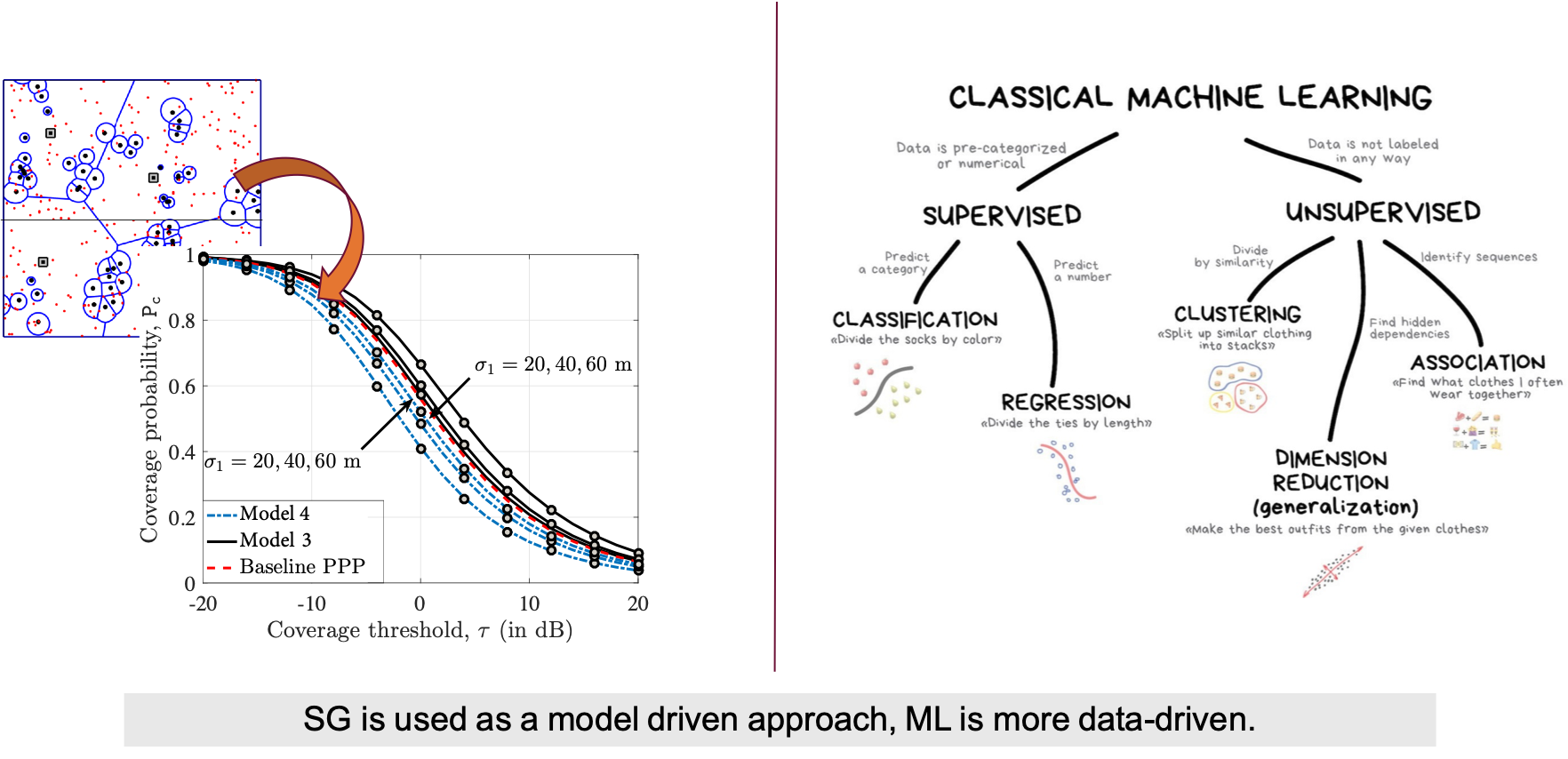
However, there is a connection..
In wireless networks, many problems can be formulated as subset selection problems where the goal is to select a subset from the ground set with the objective of maximizing some objective function. These problems are typically NP-hard and hence solved through carefully constructed heuristics, which are themselves mostly NP-complete and thus not easily applicable to large networks. On the other hand, subset selection problems occur in slightly different context in machine learning (ML) where the goal is to select a subset of high quality yet diverse items from a ground set. In this work, we introduce a novel DPP-based learning (DPPL) framework for efficiently solving subset selection problems in wireless networks. The DPPL is intended to replace the traditional optimization algorithms for subset selection by learning the quality-diversity trade-off in the optimal subsets selected by an optimization routine. As a case study, we apply DPPL to the wireless link scheduling problem, where the goal is to determine the subset of simultaneously active links which maximizes the network-wide sum-rate. We demonstrate that the proposed DPPL approaches the optimal solution with significantly lower computational complexity than the popular optimization algorithms used for this problem in the literature.