
Poisson Cluster Process: Theories and Application in Wireless Network Models
This page maintains our progress on the Poisson cluster process (PCP)-based modeling and analysis of cellular networks.
A brief background
Stochastic geometry (SG) has emerged as a powerful tool for modelling and analysis of wireless cellular networks. Using the distributions of random point patterns, which are the key offerings of this subject, it is possible to derive easy-to-compute analytical expressions of key network performance metrics like coverage, rate, area-spectral efficiency and draw useful inferences avoiding computationally expensive and time-consuming system-level simulations of cellular networks. In the SG-based models, the locations of base stations (BSs) and users in a cellular network modeld are modeled using random point patterns (also known as point processes). The most simplest point process is known as the homogeneous Poisson point process which assumes that all the points are distributed independently and uniformly at random over a space. Here is an example of a homogeneous PPP in $\mathbb{R}^2$.
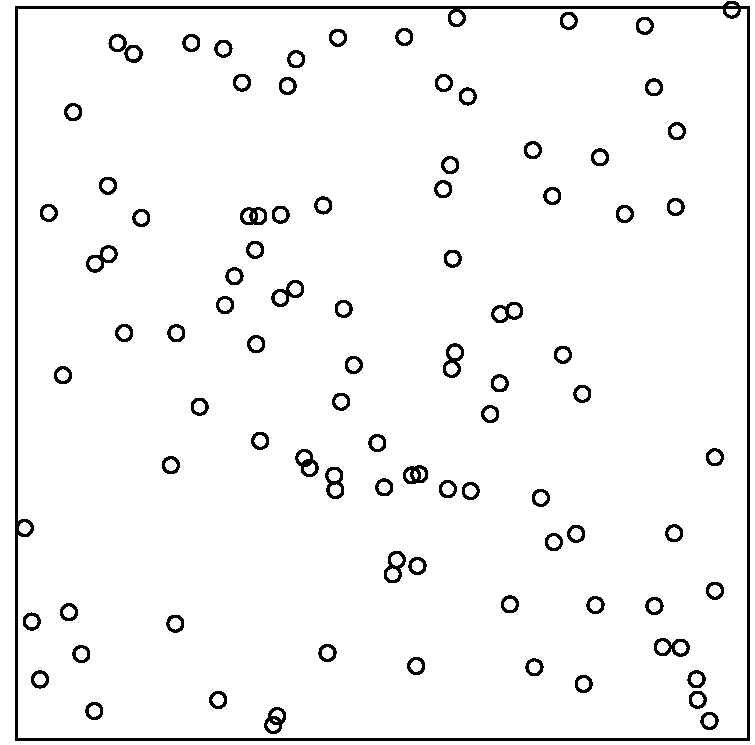
Most of the SG-based models of cellular networks assume that the base stations (BSs) and users are distributed as independent homogeneous PPPs. This means that BS and users are located independently and uniformly at random over a plane. This model is known as the baseline PPP model. However, this model is is valid for a handful of deployment scenarios, for instance traditional macro-cellular networks, it is not a representative model for a more heterogeneous network setup where smallcells are overlaid on macro cells to fill coverage dead-zones and target user hotspots with high capacity demand.
The point patterns of users and BSs in a heterogeneous cellular network (HetNet) are in most cases non-Poissonian, with multiple sources of spatial coupling, such as user-user, user-BS, BS-BS couplings. Among non-Poisson point processes, Poisson cluster process (PCP) closely resembles the point pattern of numerous realistic user and BS configurations in HetNets, such as users forming hotspot and smallcells under user-centric deployment. A PCP in $\mathbb{R}^2$ looks like this.

An important motivation to use PCP as the spatial model of users and BSs (mostly small cell BSs) in a HetNet is its resemblence with the network layouts considered in the 3GPP-compiant network simulators. Also quite interestingly, unlike many other non-Poisson processes, we found that the PCP-based HetNet models are quite amenable to mathematical analysis as well. In the series of papers, we have built the theory of PCP-based network models and have found the analytical expressions of network performance metrics.
Key References
Here are some key references on the modeling and analysis of PCP-based networks.
Distance Distributions
[J11] M. Afshang, C. Saha, H. S. Dhillon, “Equi-coverage Contours in Cellular Networks”, IEEE Wireless Communications Letters, to appear. (arXiv)
[J10] C. Saha, M. Afshang, H. S. Dhillon, “3GPP-inspired HetNet Model using Poisson Cluster Process: Sum-product Functionals and Downlink Coverage”, IEEE Transactions on Communications, to appear. (arXiv)
[J9] M. Afshang, H. S. Dhillon, “Poisson Cluster Process Based Analysis of HetNets with Correlated User and Base Station Locations”, IEEE Transactions on Wireless Communications, vol. 17, no. 4, pp. 2417-2431, Apr. 2018. (arXiv)
[J8] M. Afshang, C. Saha, H. S. Dhillon, “Nearest-Neighbor and Contact Distance Distributions for Matern Cluster Process”, IEEE Communications Letters, vol. 21, no. 12, pp. 2686-2689, Dec. 2017. (arXiv)
[J6] M. Afshang, H. S. Dhillon, “Fundamentals of Modeling Finite Wireless Networks using Binomial Point Process”, IEEE Transactions on Wireless Communications, vol. 16, no. 5, pp. 3355-3370, May 2017. (arXiv)
[J5] C. Saha, M. Afshang, H. S. Dhillon, “Enriched K-Tier HetNet Model to Enable the Analysis of User-Centric Small Cell Deployments”, IEEE Transactions on Wireless Communications, vol. 16, no. 3, pp. 1593-1608, Mar. 2017. (arXiv)
[J4] M. Afshang, C. Saha, H. S. Dhillon, “Nearest-Neighbor and Contact Distance Distributions for Thomas Cluster Process”, IEEE Wireless Communications Letters, vol. 6, no. 1, pp. 130-133, Feb. 2017. (arXiv)
[J2] M. Afshang, H. S. Dhillon, and P. H. J. Chong, “Fundamentals of Cluster-Centric Content Placement in Cache-Enabled Device-to-Device Networks”, IEEE Transactions on Communications, vol. 64, no. 6, pp. 2511-2526, Jun. 2016. (arXiv)
[J1] M. Afshang, H. S. Dhillon, and P. H. J. Chong, “Modeling and Performance Analysis of Clustered Device-to-Device Networks”, IEEE Transactions on Wireless Communications, vol. 15, no. 7, pp. 4957-4972, Jul. 2016. (arXiv)